
Databricks Recognized as a 2025 Gartner Leader for Unified Cloud Databases and AI-Driven Data Platforms
3 min read
Table of Contents
Databricks Shines in Gartner's 2025 Cloud Database Magic Quadrant
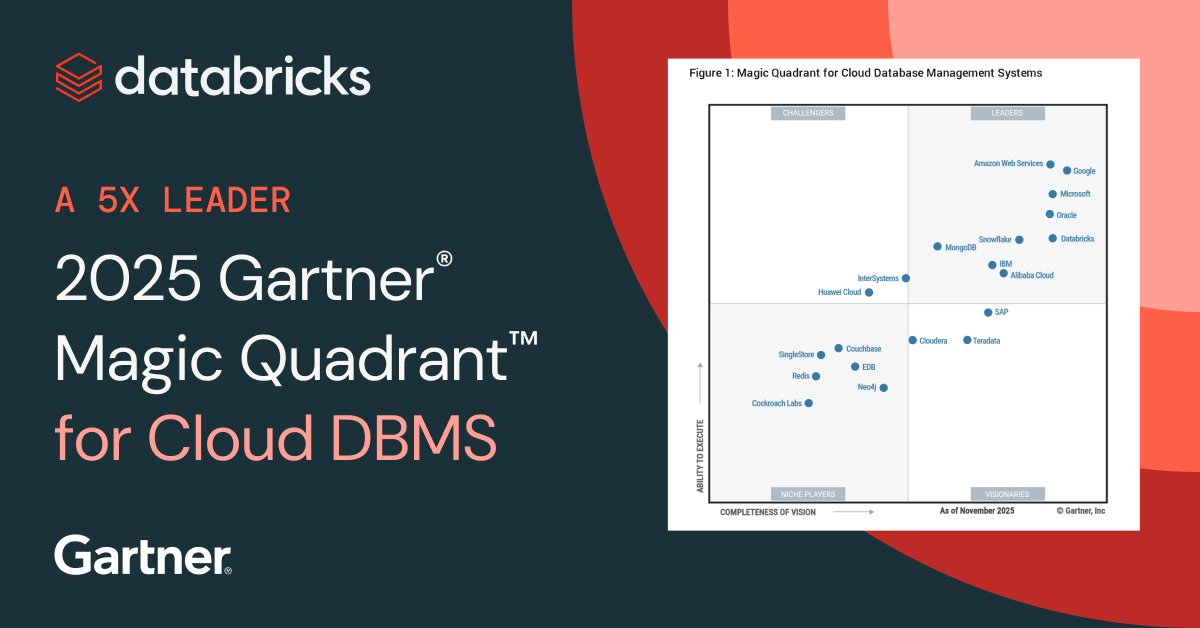
Databricks has been named a Leader in the 2025 Gartner Magic Quadrant for Cloud Database Management Systems, marking the company’s fifth consecutive appearance in this category. In 2025, Gartner evaluated Databricks not only for its analytical capabilities but also for operational database workloads, reflecting the introduction of Lakebase as part of the platform.
Invest in top private AI companies before IPO, via a Swiss platform:
Invest in AI Unicorns - OpenAI, Anthropic & More | Smartprofit Finder AG
Own a piece of OpenAI, Anthropic & the companies changing the world. Swiss-regulated investment platform. Start with just $10,000.
 Smartprofit Finder AG
From Analytics Specialist to Unified Data Powerhouse
Historically, Databricks has been recognized for supporting analytical workloads, including business intelligence, advanced analytics, and AI model development. The 2025 evaluation highlights an expanded scope: Databricks is now positioned as a unified environment capable of hosting both operational and analytical data processes within a single platform.
Lakebase: Bringing Transactions and Analytics Under One Roof
A central development in this year’s recognition is Lakebase, a fully managed, PostgreSQL-compatible operational database integrated into the Databricks Data Intelligence Platform. Lakebase allows transactional applications to operate within the same environment that processes analytical queries and AI workloads.
By aligning operational data with the platform’s unified governance, metadata, and security layers, Lakebase reduces the need to maintain multiple database engines. Applications can access live transactional data while also benefiting from analytical insights or AI signals generated within the same ecosystem.
Strength in Analytics: Databricks SQL and the Lakehouse
Databricks’ analytical engine remains a core part of its offering. Databricks SQL supports high-performance analytics for both traditional BI and more advanced analytical patterns. Combined with Lakeflow—used for data preparation and transformation—the platform provides a consistent environment for data engineering and analysis.
The lakehouse architecture continues to serve as the foundation, now extended to incorporate operational data through Lakebase.
Unity Catalog: One Governance System for Data and AI
Unity Catalog provides centralized governance, access control, and metadata management across the Databricks platform. With the addition of Lakebase, operational tables automatically inherit governance rules already applied to analytical and AI datasets.
This shared governance layer supports consistent security policies, lineage tracking, and metadata management without requiring separate systems for different workload types.
Innovation as a Defining Strength
Gartner’s 2025 assessment highlights Databricks’ pace of product development. Over the past year, the platform has expanded its functionality through several new capabilities, including:
- Agent Bricks, enabling the creation and deployment of AI agents operating on governed company data.
- Enhancements to Lakeflow, offering additional low-code and no-code data engineering features.
- New AI/BI tools that introduce natural language interactions and governed metrics.
- Broader support for open data formats such as Delta Lake and Apache Iceberg, strengthened by the acquisition of Tabular.
These developments reflect a continued expansion of the platform into a unified data and AI environment.
Why This Leadership Matters for Organizations
The 2025 Gartner designation signals Databricks’ role as a platform supporting integrated data, analytics, and AI workloads. Organizations adopting the Databricks Data Intelligence Platform can consolidate operational and analytical processes within a unified environment, reducing duplication across systems and improving visibility through shared governance mechanisms.
Lakebase Architecture and Unified Workloads
Lakebase is a fully managed operational database compatible with PostgreSQL and embedded directly within the Databricks platform. It supports transactional workloads while coexisting with analytical and AI processes in the same architecture.
Because data resides within one system, operational tables can be queried immediately for analytics or consumed directly by AI components. This unification removes the need for complex pipelines or duplicated datasets, enabling applications to work with up-to-date information while maintaining consistent governance across all data assets.
Databricks Named a Leader in 2025 Gartner® Magic Quadrant™ for Cloud Database Management Systems
Gartner has recognized Databricks as a Leader for a fifth consecutive year in the 2025 Gartner® Magic Quadrant™ for Cloud Database Management Systems.
 Ina Felsheim