

Erebor: Banking the AI Infrastructure Boom
5 min read
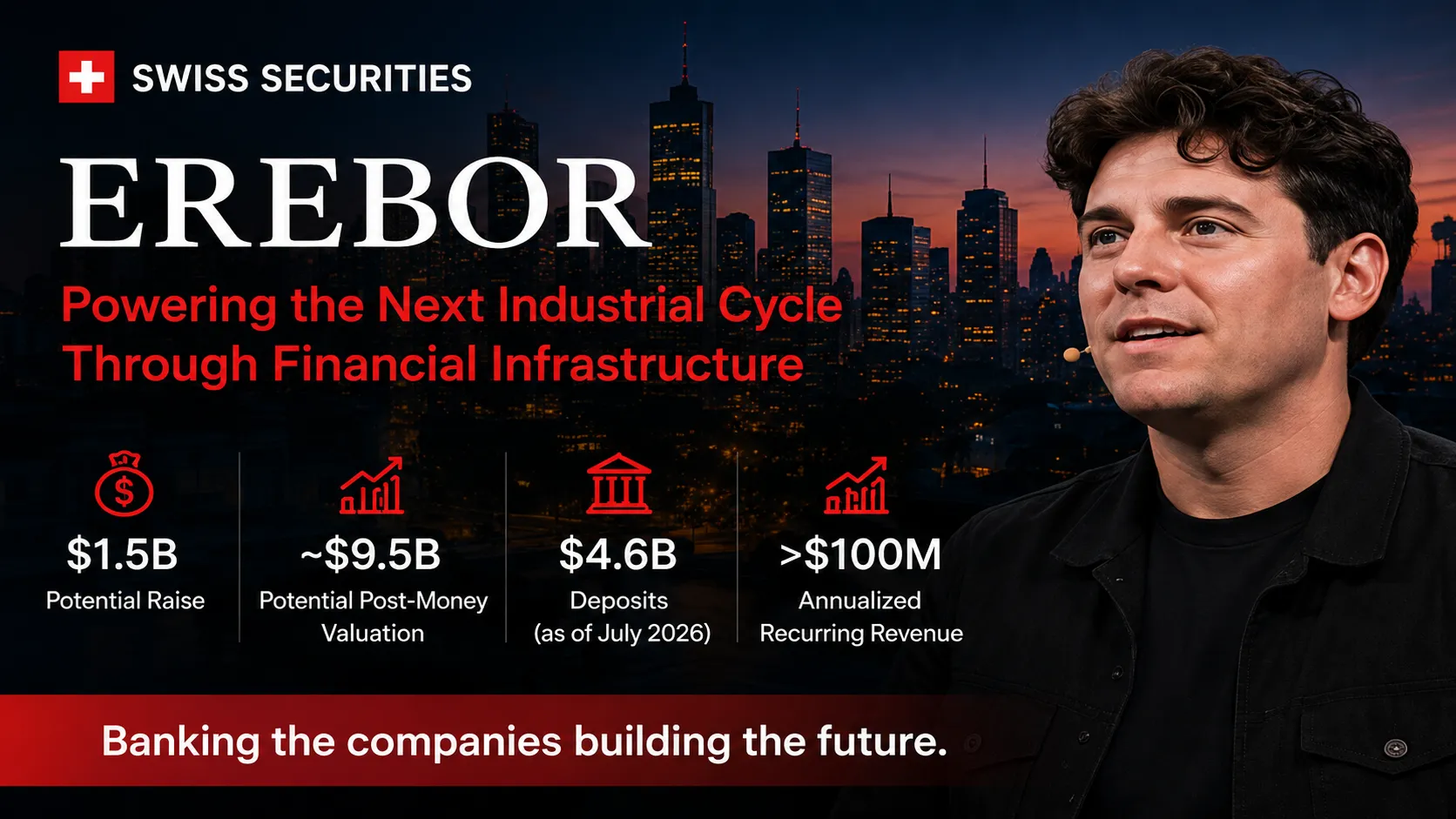
Table of Contents
The Hidden Financial Engine Powering the AI Build-Out
The AI boom looks like a story about software, chips, and data centers. Underneath sits a quieter force: highly specialized financial support for businesses needing enormous capital before their economics stabilize. This changes the investment conversation profoundly.
Invest in top private AI companies before IPO, via a Swiss platform:
Swiss Securities | Invest in Pre-IPO AI Companies
Own a piece of OpenAI, Anthropic & the companies changing the world. Swiss-regulated investment platform for qualified investors. Access pre-IPO AI shares through Swiss ISIN certificates.
 SmartProfit Finder AG
As artificial intelligence evolves from a software trend into an industrial system, the supporting cast becomes impossible to ignore. Data centers must be financed. Energy projects must be funded. Hardware must be purchased. None of that happens without a financial backbone.
Many advanced technology businesses don't behave like traditional companies. They spend heavily upfront, betting on explosive future demand. Traditional lenders struggle to assess them. A specialist bank solves that mismatch.
Big technological leaps don't run on enthusiasm alone. Railroads needed financiers. Electrification needed financiers. The internet needed financiers. AI is no different. It runs on code but is built with steel, concrete, power cables, and balance sheets.
A company serving as financial infrastructure for the AI build-out places itself at the center of the system. If it succeeds, it benefits from growth across the entire ecosystem rather than relying on one product cycle. Banking relationships are sticky — once treasury functions and borrowing facilities are established, switching is painful, creating durable commercial ties.
Why the Reported Financing Sparked Attention
A reported financing of around $1.5 billion at a valuation of roughly $9.5 billion sends a clear message: investors believe a bank focused on AI infrastructure could occupy an important strategic position. Large pools of capital appear to be treating it as a possible foundational layer in a fast-growing industrial ecosystem.
Still, reported does not mean completed. Terms can change. Valuations can move. Until financing officially closes, the story remains partly expectation. A house isn't sold because someone intends to buy it — the sale matters when documents are signed.
Even so, such terms being discussed signals that financial infrastructure has moved from the sidelines to center stage. It captures the moment investors move beyond pure technology and start funding the surrounding ecosystem — a sign of thematic maturation. Early booms chase invention; the next phase chases enablers.
Valuation is a statement about expectations, not proof of results. Can deposits stay? Can lending be done profitably? Can risk be managed through a cycle? Those are the real questions beneath the glamour of the funding headline.
Deposit Growth, Revenue Momentum, and What Adoption Really Means
When deposits rise from roughly $1.1 billion in March to about $4.6 billion by July, attention follows. Deposits are not applause — they are action. Companies don't move significant balances without trusting the institution or valuing the relationship.
But deposit growth is a signal, not a conclusion. Where are deposits coming from? Are they concentrated in a few customers? Are they operating balances or opportunistic funds quick to leave? Some money behaves like furniture — it stays put. Other money behaves like luggage — it disappears quickly.
Reported annualized recurring revenue above $100 million suggests activity is producing real economic output. Together, deposit growth and revenue momentum indicate the bank may be moving beyond concept into operating relevance. In financial services, that combination is powerful because scale improves economics when paired with sound execution.
The broader opportunity is significant. A technology-focused bank becoming the natural home for AI infrastructure companies opens doors to payments, treasury management, credit products, and long-term financing relationships. The initial deposit is often the first handshake in a much larger partnership.
Sustainable franchises aren't built by chasing balances at any cost. The real triumph isn't gathering money quickly — it's proving the money stays, works, and supports a business built to last.
Why AI Infrastructure Needs Specialist Finance
AI can seem weightless, but the reality beneath is industrial and expensive. Chips, servers, power, cooling, facilities, and working capital are all needed long before profits become predictable. Traditional lending models built around stable financial histories struggle here.
A specialist lender assesses a wider set of factors — equity investor quality, hardware assets, compute contracts, energy agreements, and forward demand assumptions. Standard lenders may see uncertainty where specialists see structure. This domain knowledge becomes a serious competitive advantage.
Specialist finance doesn't ignore risk — it understands it more intelligently. The winners in finance during technology waves are institutions that learn fastest, price risk thoughtfully, and structure products reflecting real industry needs.
A technology-focused bank bridges the gap between venture capital and conventional banking. Venture capital funds growth but is expensive equity. Traditional lending is cheaper but hard to access without mature financials. A specialist bank sits between the two, lowering overall cost of capital and supporting faster scaling.
Finance here is not passive — it's an accelerant. Better financial tools unlock more data centers, energy solutions, hardware deployment, and manufacturing output. The institutions that understand this early may become some of the most important enablers of the entire era.
Infrastructure Lending, Execution Risk, and What Investors Should Watch
Concrete transactions pull the conversation back to earth. A financing linked to Valar Atomics — combining a large equity raise with a credit facility led by a specialist bank — demonstrates how pieces fit together in practice, connecting banking directly to AI's physical foundation, including power capacity.
Compute cannot run on optimism. It runs on electrons. If advanced energy systems are needed for AI scale, financing those systems becomes part of the AI investment thesis. A bank funding these assets positions itself close to the most essential bottlenecks in the market.
But specialization requires execution. In financial services, execution means underwriting loans carefully, managing liquidity responsibly, meeting regulatory requirements, and maintaining discipline when markets move fast. Rapid growth can flatter any model temporarily — institutions built for speed without resilience discover that growth amplified their weaknesses.
Investors should watch not just lending activity but lending quality. Are loans extended against prudently valued assets? Is the deposit base diversified? Are compliance capabilities keeping pace with expansion? Are relationships deepening across treasury, payments, and multiple financing needs — or limited to single transactions?
Confirmation of financing terms, clearer disclosure around deposits and revenue, and continued evidence of substantial lending relationships will help investors separate durable progress from early hype. Strong institutions make it easier for outsiders to understand how they're growing and what risks they're taking.
The AI economy is broadening beyond software and chips to include the financing of power, compute, and industrial infrastructure. A well-executed banking model tied to this capital-intensive backbone may participate in growth across multiple sectors simultaneously.
The AI age needs power, hardware, facilities, and capital. The winners won't just be those who invent the future — but those who finance it wisely. Growth is exciting. Control is decisive.