


NVIDIA’s AI Infrastructure Surge
3 min read
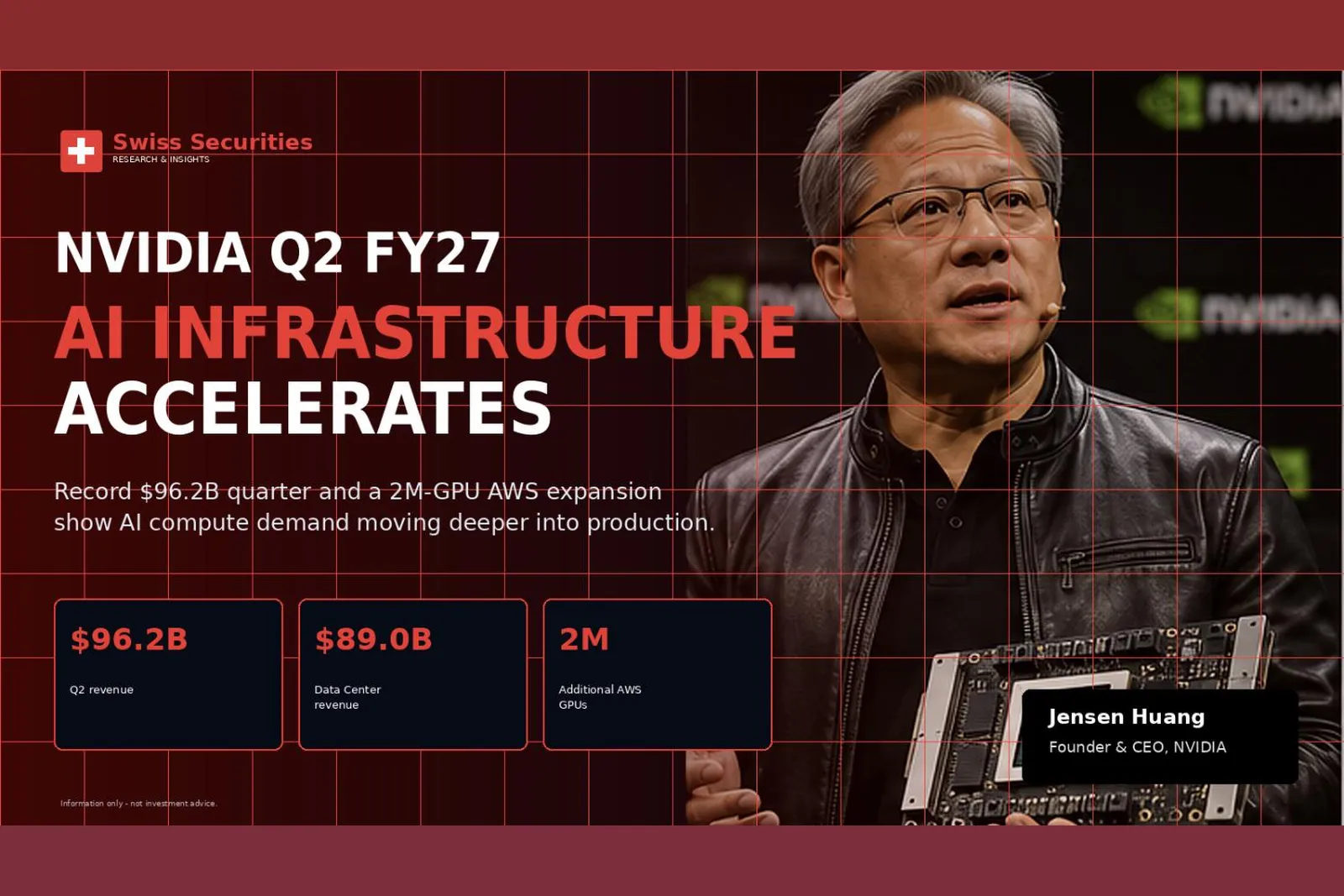
Table of Contents
The Quarter That Made the AI Boom Impossible to Ignore
NVIDIA's latest results make one thing clear: AI has crossed from experimentation into infrastructure. Revenue hit $96.2 billion, with Data Center alone delivering $89.0 billion—numbers that signal AI is becoming a core utility, not a pilot program. Year-over-year growth of 106% from an already massive base suggests demand is broadening, not fading. The company projected roughly $108.0 billion next quarter, pushing past the $100 billion threshold and reshaping expectations entirely. AI is no longer waiting for its moment. The moment has arrived.
Data Centers: The New Factories of Intelligence
With $89.0 billion of $96.2 billion in quarterly revenue flowing from Data Center, this segment is NVIDIA's undisputed center of gravity. Today's leading data centers are active intelligence factories—processing information, training models, powering automation, and supporting physical-world robotics. NVIDIA's advantage lies in selling complete systems: compute, networking, memory coordination, and software in one optimized environment. Its Vera Rubin platform entering full production across major cloud partners signals customers are committing to an architecture, not just a component—a distinction that builds lasting competitive moats.
Invest in top private AI companies before IPO, via a Swiss platform:
Swiss Securities | Invest in Pre-IPO AI Companies
Own a piece of OpenAI, Anthropic & the companies changing the world. Swiss-regulated investment platform for qualified investors. Access pre-IPO AI shares through Swiss ISIN certificates.
 SmartProfit Finder AG
AWS Expansion: AI Demand Becomes Long-Term Infrastructure
AWS's plan to deploy 2 million additional NVIDIA GPUs through 2027–2028—spanning Blackwell Ultra, Rubin, and Rubin Ultra systems—is perhaps the clearest proof that AI has moved from curiosity to capital commitment. The targeted workloads tell the real story: agentic AI, scientific discovery, enterprise automation, and robotics. That breadth means AI is becoming operational expenditure, not just innovation spending. Companies aren't testing AI anymore—their businesses increasingly run on it. This self-reinforcing loop, more infrastructure enabling more adoption enabling more infrastructure, is exactly what separates a technology trend from a technology era.
From Chips to Full AI Factories
NVIDIA's deepest strategic move is owning more of the complete AI stack. Alongside GPUs, it is advancing Vera CPUs, Spectrum networking, NVLink interconnects, CUDA software libraries, open models, and robotics platforms. Better networking eliminates bottlenecks between thousands of cooperating chips. CUDA's developer ecosystem creates switching costs that reinforce hardware loyalty. Robotics extends AI into warehouses, logistics, and autonomous systems. A pure chip company rides demand cycles; a platform architect captures value across multiple layers simultaneously. Technology history rewards those who define the architecture of a new era—and NVIDIA is positioning itself to do exactly that.
What Investors Are Really Watching
Strong demand is the easy part. The harder question is execution. Converting orders into shipments requires coordinating chip manufacturing, memory supply, networking components, power infrastructure, and customer deployment—all at unprecedented scale. Margin trends matter too: growth is exciting, but profitability confirms real economic power. Customer concentration among a few hyperscalers and the rise of custom silicon alternatives are genuine risks worth monitoring. Yet in a rapidly expanding market, the decisive variable is often the least glamorous: delivery. Vision opens the door; execution keeps it open. NVIDIA is not just selling into a boom—it is being tested on whether it can keep building the backbone of one.