
Anthropic Revenue Soars Ahead of IPO
4 min read
Table of Contents
Anthropic's Revenue Explosion Changes the AI Race
One number can redefine how investors view an industry: $65 billion. That is Anthropic's annualized revenue run rate, signaling more than rapid growth. It suggests that artificial intelligence is moving beyond experimentation among major customers and becoming embedded in everyday business operations. Companies are buying, deploying, and expanding AI tools at a pace that is beginning to translate technological adoption into substantial recurring revenue. With the run rate reportedly increasing roughly sevenfold from a year earlier, Anthropic is demonstrating the scale that can emerge when enterprise AI becomes operational rather than experimental.
Invest in top private AI companies before IPO, via a Swiss platform:
Swiss Securities | Invest in Pre-IPO AI Companies
Own a piece of OpenAI, Anthropic & the companies changing the world. Swiss-regulated investment platform for qualified investors. Access pre-IPO AI shares through Swiss ISIN certificates.
 SmartProfit Finder AG
Commercial adoption becomes more significant when customers stop evaluating whether they need a technology and begin deciding how broadly to deploy it. Once AI tools become integrated into coding, research, analysis, document preparation, and communication, switching providers can involve retraining employees, rebuilding workflows, and reconnecting internal data. Strong revenue momentum therefore provides evidence that generative AI is creating measurable commercial value and moving closer to becoming an established layer of enterprise technology.
Enterprise Demand Is Making AI a Necessity
Technology becomes economically important when it consistently improves how organizations operate. Anthropic's growth appears increasingly tied to enterprise adoption, where buyers typically evaluate security, reliability, governance, and measurable productivity before committing to large-scale deployments. Generative AI is now being used for software development, document analysis, customer support, research, and decision support—functions closely connected to everyday business operations rather than isolated experimentation.
As deployments prove useful, adoption can reinforce itself: greater usage increases employee familiarity, familiarity builds confidence, and confidence supports expansion into additional workflows. Enterprise customers also create meaningful switching costs because teams adapt processes, connect data sources, establish governance frameworks, and build applications around a chosen provider. One of the clearest indications of maturity is that AI spending is increasingly moving from experimental innovation budgets toward recurring operating expenditure, creating more durable customer relationships and greater revenue visibility.
The Coming IPO Puts Anthropic Before Public Judgment
Anthropic has reportedly taken confidential steps toward an initial public offering, potentially transforming one of the fastest-growing private AI companies into a closely scrutinized public business. Public investors will evaluate more than headline growth. Revenue durability, customer concentration, gross margins, computing costs, capital requirements, and competitive resilience will all become central to determining how the market values the company. Strong growth provides an attractive narrative, but public ownership introduces continuous accountability and quarterly measurement.
If investors were to value Anthropic near the trillion-dollar level, that valuation would imply expectations that AI becomes a foundational component of the global economy and that the company captures a meaningful share of that opportunity. A large public listing could also affect sentiment across semiconductors, cloud infrastructure, enterprise software, and other parts of the AI ecosystem. Ultimately, however, public markets will focus on execution: retaining customers, improving margins, managing infrastructure costs, navigating regulation, and maintaining technological competitiveness as the industry matures.
The Rivalry With OpenAI Is Rewriting Competition
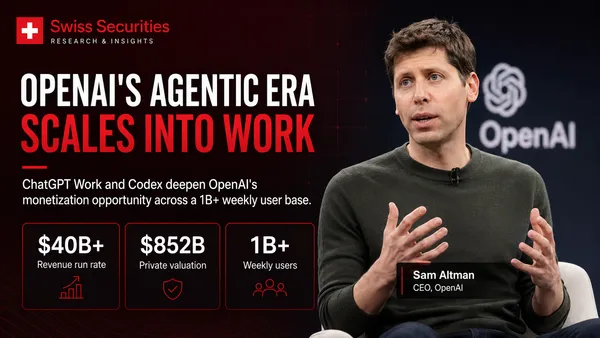
Anthropic's reported $65 billion annualized revenue run rate compared with OpenAI's reported $40 billion highlights the scale emerging among leading AI companies. Competition between the two extends beyond model performance into enterprise distribution, developer ecosystems, pricing, computing capacity, and long-term customer relationships. The larger strategic objective is becoming embedded in the technology infrastructure businesses depend on rather than simply selling access to individual AI products.
Strong competitors can also validate the broader market by giving enterprise customers multiple credible providers and reducing concerns about relying on a single emerging technology supplier. At the same time, the competitive advantage increasingly depends on customer integration. Once organizations connect internal data, redesign workflows, establish governance standards, and train employees around a particular AI platform, changing providers becomes more costly. Leadership today therefore matters less than the ability to build durable enterprise relationships, maintain technological relevance, and convert scale into sustainable economics over time.
Political Friction Reveals the Hidden Price of AI Power
As advanced AI becomes more economically and strategically important, governments are increasing their involvement through export controls, national-security requirements, procurement policies, and regulation. Frontier models can influence defense capabilities, intelligence analysis, cybersecurity, and national competitiveness, making access to advanced AI an issue that extends beyond commercial markets. For leading AI companies, growth therefore requires managing relationships not only with customers and investors but also with regulators and national-security authorities.
Greater strategic importance inevitably brings greater scrutiny. Companies operating at the frontier of AI must balance commercial expansion with regulatory compliance, geopolitical constraints, security obligations, and evolving public policy. For investors, this means that long-term leadership will depend on more than revenue growth or model quality alone. If enterprise adoption continues accelerating while public markets increasingly treat AI as core infrastructure, the strongest companies may ultimately be those combining technological capability with durable customer relationships, financial discipline, operational execution, and regulatory resilience.
Anthropic tells investors annualized revenue run rate climbed to $65 billion in July
Anthropic’s revenue run rate is up about sevenfold from a year earlier.
 Ashley Capoot,Kate Rooney