
Callosum’s $100M Bet on Smarter AI Infrastructure
4 min read
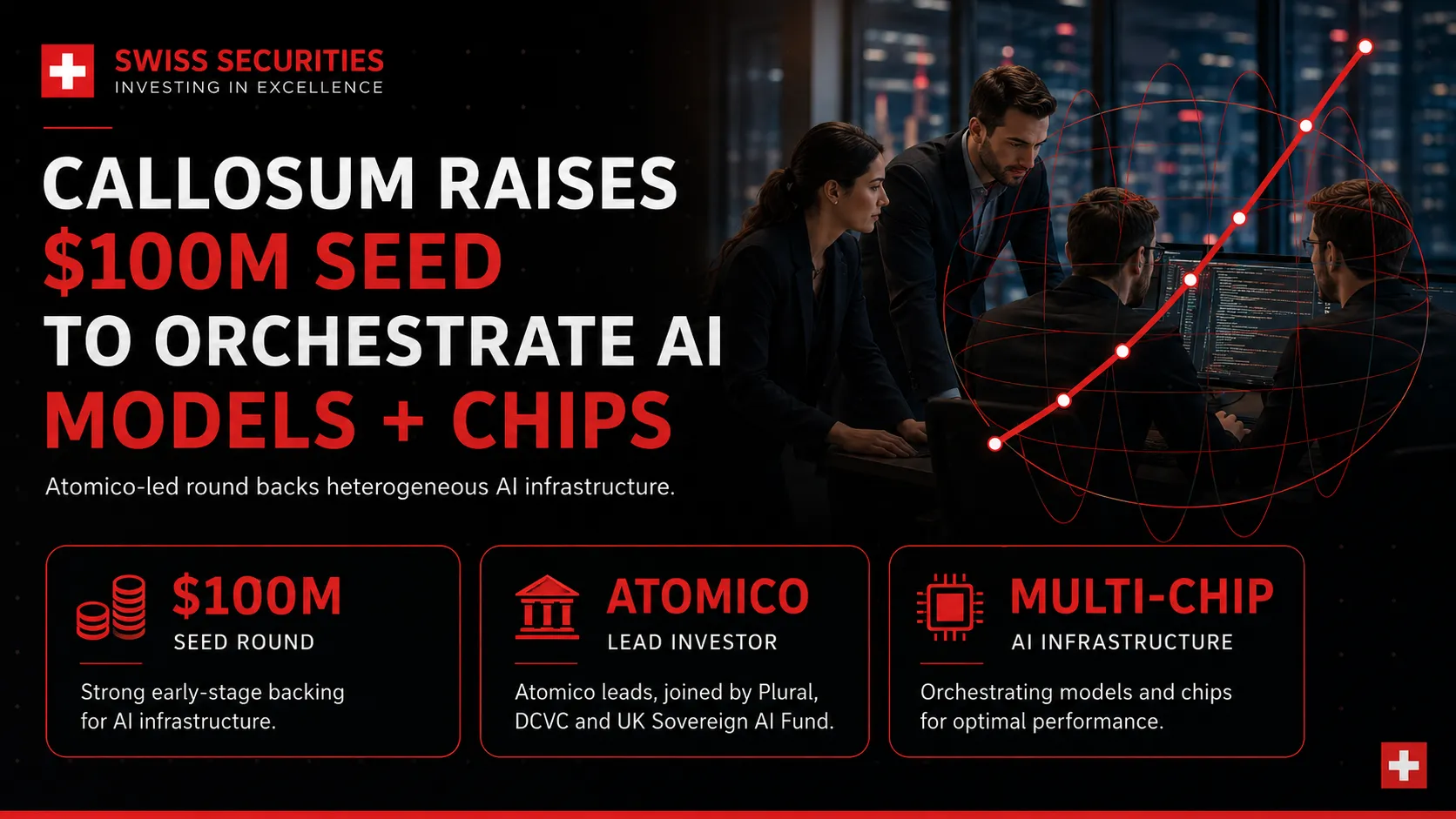
Table of Contents
The Giant Bet on the Hidden Layer of AI
Money usually chases what the world can see: dazzling apps, headline-grabbing chatbots, futuristic robots. But some of the most important fortunes in technology have been built in quiet infrastructure layers that make everything else possible. That is where excitement around Callosum begins. A $100 million seed round is not just a funding event—it is a signal flare telling the market that the next AI battle may be won not only by companies building models, but by those deciding how models are used, where they run, and which chips power them.
Invest in top private AI companies before IPO, via a Swiss platform:
Swiss Securities | Invest in Pre-IPO AI Companies
Own a piece of OpenAI, Anthropic & the companies changing the world. Swiss-regulated investment platform for qualified investors. Access pre-IPO AI shares through Swiss ISIN certificates.
 SmartProfit Finder AG
Callosum is positioning itself as a traffic controller for a world where AI is growing more crowded, fragmented, and expensive. When options were limited, choosing one model and one hardware class worked. Today, with many models, many chips, and tasks demanding different levels of speed and cost efficiency, that approach collapses. Investors backing this company are betting on a structural shift in how AI computing gets organized—and the orchestration layer sitting in the middle of that shift could become one of the most valuable places to stand.
Why AI Needs a Smarter Traffic Controller
Behind every smooth AI interaction is a busy industrial zone of different models, processors, and costs. Some systems are fast but expensive; others are cheap but limited. What looks like one answer on screen is often the result of complex computational decisions. Orchestration applies logistics thinking to this problem—deciding which model handles which task, at what speed, and at what cost.
Not every AI task deserves the same treatment. A simple classification job does not need a giant frontier model. A real-time interaction needs low latency more than raw sophistication. Once these distinctions are recognized, AI stops looking like a monolithic process and becomes a portfolio of jobs, each with its own best execution path. Without intelligent orchestration sitting on top, heterogeneous infrastructure turns into chaos. With it, developers get results without headaches, and enterprises get reliability without endless engineering decisions.
Tailored Inference and AI That Thinks Economically
Tailored Inference lets developers access the best mix of AI models and hardware through a clean interface while the system handles complexity behind the scenes. Inference—where trained models generate real outputs—is becoming one of the largest cost centers in enterprise AI. Every query, every agent action, every request consumes compute. At scale, those costs are enormous.
The promise is dynamic balancing of output quality, response time, energy use, and cost. A high-value legal analysis may deserve a more capable route. A lightweight summarization request does not. A latency-sensitive agent interaction needs speed-tuned hardware. A background batch job can run slowly to save money. Developers do not want to become experts in every model and silicon architecture—they want an API that delivers better economics and performance without manual optimization. Abstraction has always been technology's great unlock, and Tailored Inference aims to do for fragmented AI compute what cloud computing did for server management.
The New Power Struggle: The Layer in Between
AI is fragmenting in multiple directions. Proprietary models compete with rapidly improving open models. GPUs share hardware territory with specialized accelerators and emerging silicon platforms. Cloud providers bundle complexity into services designed to retain customers. Customers, meanwhile, want choice, flexibility, and lower costs.
An independent orchestration layer steps into the middle of that tension as a neutral decision engine. Historically, these in-between layers have become enormously valuable—operating systems connected hardware and software, middleware connected applications and infrastructure. The winning pattern is consistent: when underlying ecosystems grow too complex, abstraction layers capture outsized value. A company positioned between multiple parts of the AI stack benefits from growth across the entire ecosystem rather than betting on one model or one chip, turning market fragmentation from a problem into a durable product opportunity.
The Investor Lens: Massive Opportunity, Brutal Execution
The opportunity is real, but so are the risks. Customers will demand repeatable gains across production workloads—not carefully chosen demonstrations. Enterprises bring existing security requirements, compliance expectations, and legacy architecture, meaning ease of integration is a core value proposition, not a minor feature. Large cloud providers, model vendors, and chip makers all have reasons to build closer to orchestration, so differentiation must be meaningful and sustained.
If Callosum executes, it could become part of the default architecture for AI deployment. Developers building around its APIs and enterprises relying on it to manage complex workloads would find switching costly—the kind of stickiness that turns infrastructure software into a powerful, recurring business. Every new model update and hardware shift reinforces the need for the layer keeping everything running efficiently. The vision is bold, but the scoreboard will be practical. In AI infrastructure, brilliance is admired. Delivery is what gets paid.