

Castelion’s $1B Raise Fuels Hypersonic Defense Manufacturing Expansion
5 min read
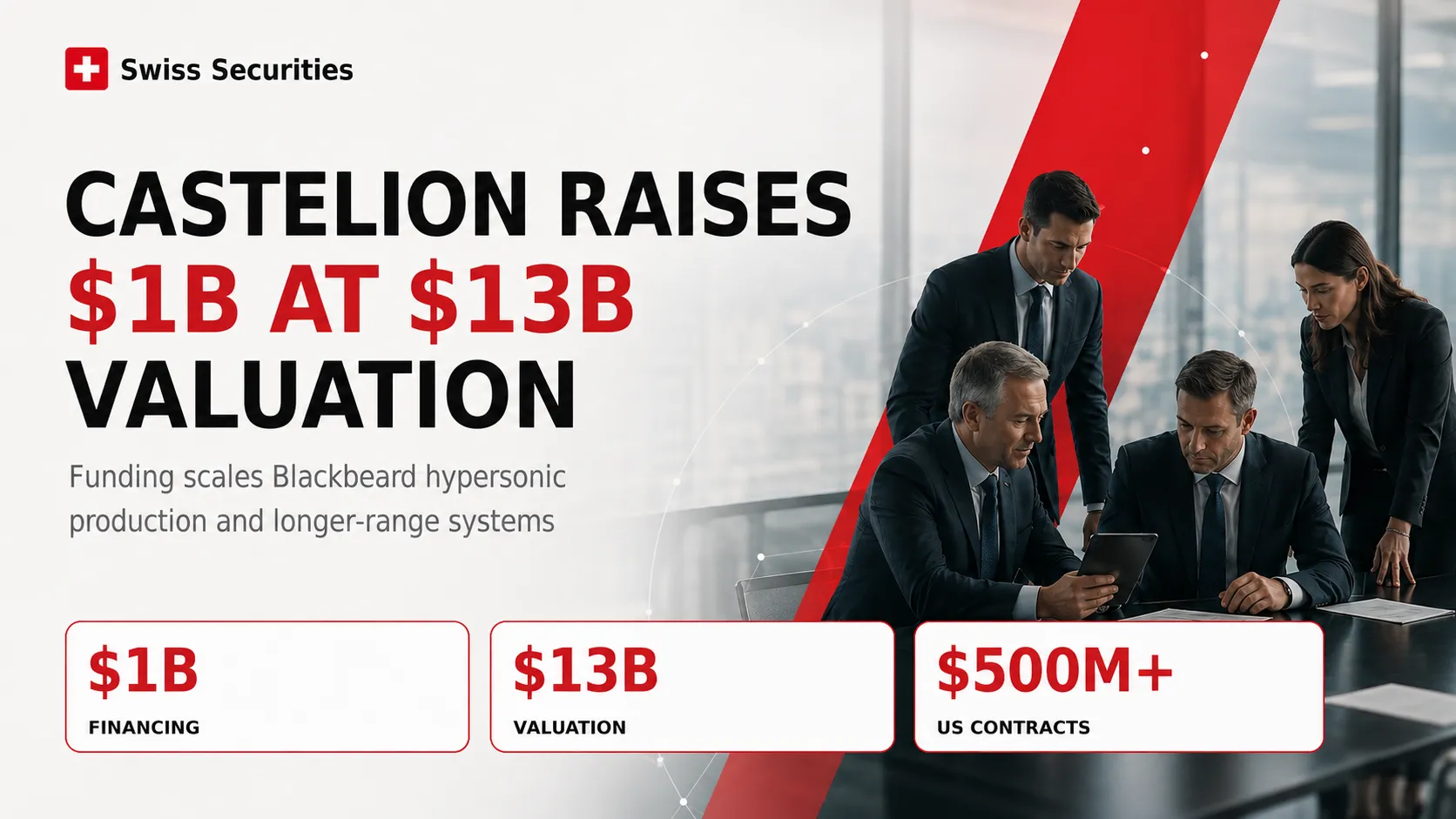
Table of Contents
A Billion-Dollar Bet on the New Defense Economy
A powerful shift is racing through global defense, fueled by something investors understand instantly: capital at scale. Castelion's massive financing marks a moment when private markets treat defense manufacturing not as a slow, bureaucratic corner of industry, but as a high-growth arena where speed, software thinking, and industrial muscle combine to create something transformative.
Invest in top private AI companies before IPO, via a Swiss platform:
Swiss Securities | Invest in Pre-IPO AI Companies
Own a piece of OpenAI, Anthropic & the companies changing the world. Swiss-regulated investment platform for qualified investors. Access pre-IPO AI shares through Swiss ISIN certificates.
 SmartProfit Finder AG
Governments want better tools, bigger inventories, and faster delivery. Traditional systems have struggled to meet those demands quickly or cheaply enough. Into that gap steps a new type of company, building hardware with the urgency and iteration style of technology startups. Investors are not just buying a product. They are buying a new operating model for national security.
The financing says a great deal. Equity gives the company firepower to invest aggressively in production and infrastructure. Credit provides flexibility when manufacturing ramps require working capital. This is not small-scale experimentation. This is balance-sheet preparation for industrial expansion.
Recent conflicts and rising geopolitical tensions have revealed that stockpiles matter, unit cost matters, and production speed matters. Castelion sits right in that strategic sweet spot: delivering advanced strike capability at lower cost and higher volume than legacy alternatives. If advanced weapons become more affordable and easier to produce at scale, demand broadens, unlocking larger orders and more durable production contracts.
When established financial institutions, top-tier venture capital, and major investment managers all gather around the same table, the message is clear: defense technology has become investable at a new level. Physical capability is back at the center of national planning, and hardware tied to urgent demand and modern engineering can become a compelling growth story rather than a capital-intensive burden.
Blackbeard and the Race to Make Hypersonics Practical
Hypersonic weapons move at extreme speeds and are designed to be hard to intercept, compressing decision time and challenging defenses. But while strategically attractive, they have been associated with high costs and limited production. This is where Castelion's story becomes especially interesting.
The Blackbeard system is presented not simply as another advanced missile, but as a low-cost, mass-producible hypersonic strike weapon. The goal is not just to prove hypersonic capability is possible, but to make it buildable in meaningful numbers at a price point supporting real-world deployment. A weapon that performs brilliantly but remains scarce has limited strategic impact. A system combining strong capability with repeatable production can alter military planning entirely.
This practical angle turns technical buzz into an investment thesis. Lower-cost hypersonics could solve one of the biggest problems in modern defense: maintaining advanced deterrence without relying on exquisite, expensive systems impossible to stockpile. Governments want capability they can afford in volume, and a company delivering that moves from interesting to essential.
Affordability can also become a force multiplier. If one side manufactures advanced systems more cheaply and quickly, it gains flexibility, sustains inventories, and absorbs attrition more effectively. Lower cost is not merely a financial detail. It becomes part of military advantage.
For investors, Blackbeard represents urgency combined with scale. Instead of a narrow elite program, the company positions itself within a broader defense modernization cycle. The real drama lies in whether it can bridge the gap between promising technology and dependable deployment. If it can, Blackbeard becomes proof that advanced defense capability can break free from slow, expensive scarcity.
Factories Are Becoming the Strategic Weapon
In defense, ideas alone do not secure advantage. Factories do. Castelion's manufacturing expansion is one of the most important parts of the story. The Project Ranger campus in New Mexico symbolizes a strategic philosophy: instead of staying asset-light, the company embraces industrial depth. Plenty of startups demonstrate promising concepts. Far fewer convert those concepts into reliable throughput.
When demand surges, customers ask how many units can be delivered, how quickly, and at what cost. A company without manufacturing scale may win headlines but lose contracts. Building capacity also signals management confidence. Factories are physical expressions of expectation about future demand.
Modern manufacturing is not simply old industry repeated. It incorporates advanced design software, digital testing, automation, and rapid engineering feedback loops. The factory is no longer separate from the technology story. It is the technology story. A company combining modern engineering culture with serious industrial capacity rewrites what defense production can look like.
A business with credible manufacturing expansion gains strategic weight, becomes embedded in customer planning, and stands a better chance of winning larger, longer contracts. When the world demands more capability, faster replenishment, and lower cost, the winners may be those pouring concrete and building industrial muscle before everyone else catches up.
Why Investors Are Flooding Into Defense Technology
Private capital does not move in waves without reason. Security concerns have intensified globally. Governments are reassessing readiness and stockpile depth, creating real budget flows and long-term procurement interest. But demand alone does not explain the excitement. A new generation of companies is injecting speed, iteration, and cost discipline into hardware creation, suggesting both strategic relevance and venture-style upside.
Investors are increasingly comfortable with capital-intensive businesses when strategic tailwinds are strong enough. Defense technology offers alignment with government spending, strategic urgency, and long product cycles once adoption occurs. In a world shaped by geopolitical tension and renewed industrial policy, investors want exposure to businesses tied to national priorities.
Castelion's reported early contract wins add credibility, suggesting real customer interest rather than operating in a vacuum. The financing structure reveals sophistication: equity supports aggressive growth while revolving credit smooths operational needs as production ramps. That kind of structure signals planning for execution, not just publicity.
Capital inflows can create self-reinforcing advantage. More money allows faster hiring, greater production capacity, and stronger supplier relationships, which improve execution and attract more customers. Defense technology is no longer waiting politely at the market's edge. Capital is charging in, looking for companies that can turn strategic necessity into repeatable industrial growth.
The Risks, the Valuation, and What Success Would Really Look Like
Excitement lifts companies into the spotlight, but execution decides whether they stay there. Castelion's $13 billion valuation implies investors believe the company can emerge as a major production player, not merely a promising developer. That is a large expectation set.
The first risk is program execution. Hypersonic systems introduce severe engineering challenges: materials, propulsion, guidance, thermal stress, and integration all have to work together reliably. Testing milestones influence customer confidence and procurement timing. Disappointing results can force delays and reshape expectations. Procurement timing presents another challenge, as budget cycles and approval processes can create lumpy revenue even when strategic relevance is undeniable.
Scaling manufacturing safely and economically may be the most decisive challenge. It is one thing to build a few advanced units. It is another to build many, consistently, with quality control and cost discipline. Suppliers must deliver, processes must be repeatable, and costs must not spiral. The deeper the scale ambition, the more unforgiving the operational demands become.
Still, a rational case supports such confidence. Early contract traction confirms real customer interest. Strong financing provides resources to invest ahead of demand. Manufacturing expansion demonstrates commitment to the hard work of scaling. Success will be visible in a sequence of proof points: testing milestones met, production ramping without major stumbles, contracts expanding from initial awards into larger commitments, and customers viewing the company as a dependable supplier rather than an experimental option.
The valuation is ultimately a statement of belief that this company can become a defining force in modern defense manufacturing. Markets often celebrate the breakthrough and underestimate the grind. The grind is everything here, built into testing schedules, supplier agreements, and countless technical decisions that never make a headline.
The future is not waiting. In defense, scale wins, speed matters, and execution decides who gets left behind.