
Crusoe: Powering the Physical Infrastructure Behind AI
4 min read
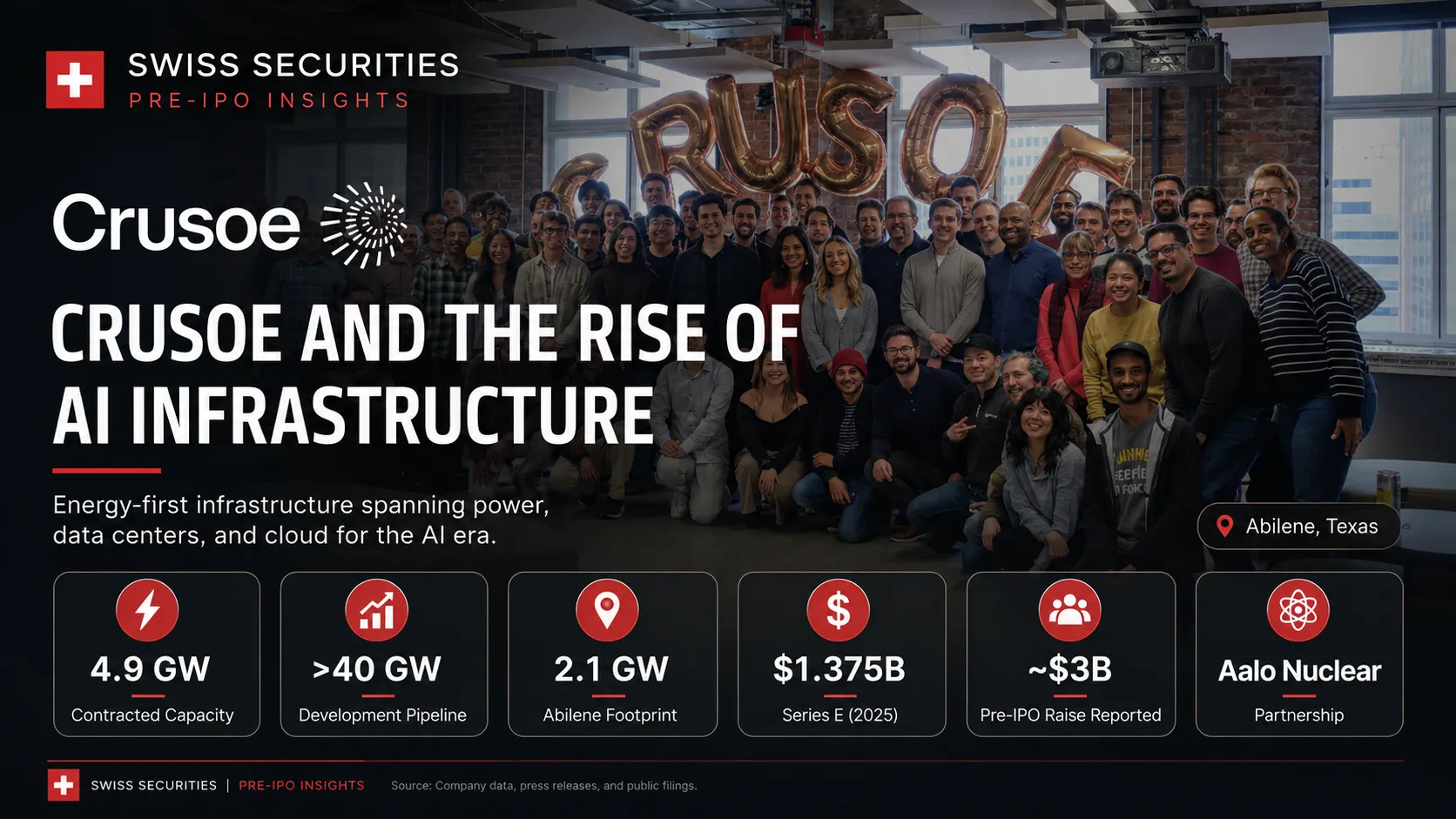
Table of Contents
The Hidden Engine of Artificial Intelligence
AI looks weightless—chatbots, image generators, code writers—but behind every response sits a hungry physical machine economy consuming electricity, land, cooling systems, and specialized chips. The glamour belongs to software; the power belongs to infrastructure.
Invest in top private AI companies before IPO, via a Swiss platform:
Swiss Securities | Invest in Pre-IPO AI Companies
Own a piece of OpenAI, Anthropic & the companies changing the world. Swiss-regulated investment platform for qualified investors. Access pre-IPO AI shares through Swiss ISIN certificates.
 SmartProfit Finder AG
Crusoe built its identity around one hard truth: AI cannot scale unless someone solves the physical bottlenecks first. Founded in 2018, it originally turned wasted natural gas into computing power, then evolved into a bridge between the energy sector and AI—assembling power, land, cooling, and compute the way past eras built roads, ports, and rail for factory revolutions.
Scarcity creates strategic value. When AI demand rises faster than supporting infrastructure, those who deliver that infrastructure become indispensable. The winners may not have the best demo, but the strongest grip on AI's physical supply chain.
From Megawatts to Models: Building a Full-Stack AI Platform
Crusoe controls multiple infrastructure layers simultaneously: large AI data centers, secured energy capacity, Crusoe Cloud for AI workloads, and Crusoe Spark for modular data-center manufacturing. These are not random business lines—they fit together like parts of a machine.
Modern AI data centers resemble power-intensive production facilities requiring resilient grid connections, sophisticated cooling, high-bandwidth networking, and rapid construction. Crusoe's flagship Abilene, Texas campus—tied to Stargate and Oracle Cloud Infrastructure—targets roughly 1.2 gigawatts. A second 900-megawatt campus supporting Microsoft brings projected Abilene capacity to approximately 2.1 gigawatts.
For investors, this full-stack strategy may create more durable economics than single-layer offerings. A company tying together energy, campuses, and compute delivery captures value at multiple points and becomes part of the system architecture itself—harder to replace than any single vendor.
The Texas Scale-Up and the New Infrastructure Race
Crusoe reported 4.9 gigawatts of contracted AI infrastructure capacity in June 2026, with a broader development pipeline exceeding 40 gigawatts. Oracle, Microsoft, Meta, and Google have all been linked to its contracted capacity—hyperscalers reserving infrastructure years in advance because the cost of being late is growing.
In July 2026, Crusoe and Lancium announced a further 1-gigawatt campus in Childress, Texas, expanding beyond one marquee site toward a network effect. That scale becomes a barrier to entry in itself—gigawatt-level projects demand utility-style planning, long-horizon commitments, and serious capital.
Still, there is a critical distinction between pipeline and operational reality. Converting planned capacity into working facilities requires disciplined execution across project management, equipment supply, regulatory navigation, and customer coordination. In infrastructure, promises attract headlines; completed capacity attracts cash flow.
Capital, Valuation, and Why Investors Are Paying Attention
Crusoe closed a $600 million Series D at a $2.8 billion valuation in December 2024. By October 2025, a $1.375 billion Series E pushed its valuation above $10 billion. Reporting from July 2026 indicated discussions for approximately $3 billion more at a valuation near $30 billion—a striking re-rating of the entire category.
Capital is not merely useful in infrastructure; it is essential. Companies with strong funding access can move earlier, reserve resources, and establish positions before rivals. Balance sheet strength may shape the AI race more than many expect. Scale improves procurement, financing credibility, and operational know-how—capital feeds capability, and capability attracts more capital.
The deeper investor question is whether Crusoe can become one of the defining platforms in a category that may itself grow dramatically. If AI demand is persistent and large enough to justify massive industrial build-outs, current capital raises look like fuel for expansion. If not, capital intensity becomes a burden. That tension—industrial build-out meeting technology disruption—is exactly what makes the story compelling.
Energy Reinvented: Nuclear, Renewables, and the Future Power Mix
Crusoe treats energy as a design challenge and strategic resource, not a background utility bill. Its infrastructure spans grid power, natural gas, solar, wind, battery storage, and behind-the-meter generation. No single source will solve AI's electricity challenge alone, so Crusoe assembles the mix most suited to each site—bringing capacity online faster and with greater resilience.
Most boldly, in July 2026 Crusoe announced a partnership with Aalo Atomics to demonstrate nuclear-powered AI infrastructure. The plan targets a modular nuclear proof-of-concept powering a Crusoe Spark data center in 2027, scaling to 50 MWe modular plants at Crusoe data centers by end of 2029. Nuclear addresses AI's hardest power problem: large amounts of reliable, continuous, low-carbon electricity around the clock—something intermittent renewables alone cannot guarantee.
This portfolio energy mindset has broad investor implications. The AI boom is pulling forward investment across the entire energy ecosystem—generation planning, storage deployment, transmission, and potentially new nuclear development. Companies sitting at that intersection benefit from multiple structural trends simultaneously.