
Nvidia-Perplexity Funding Talks at $30B+ Valuation
3 min read
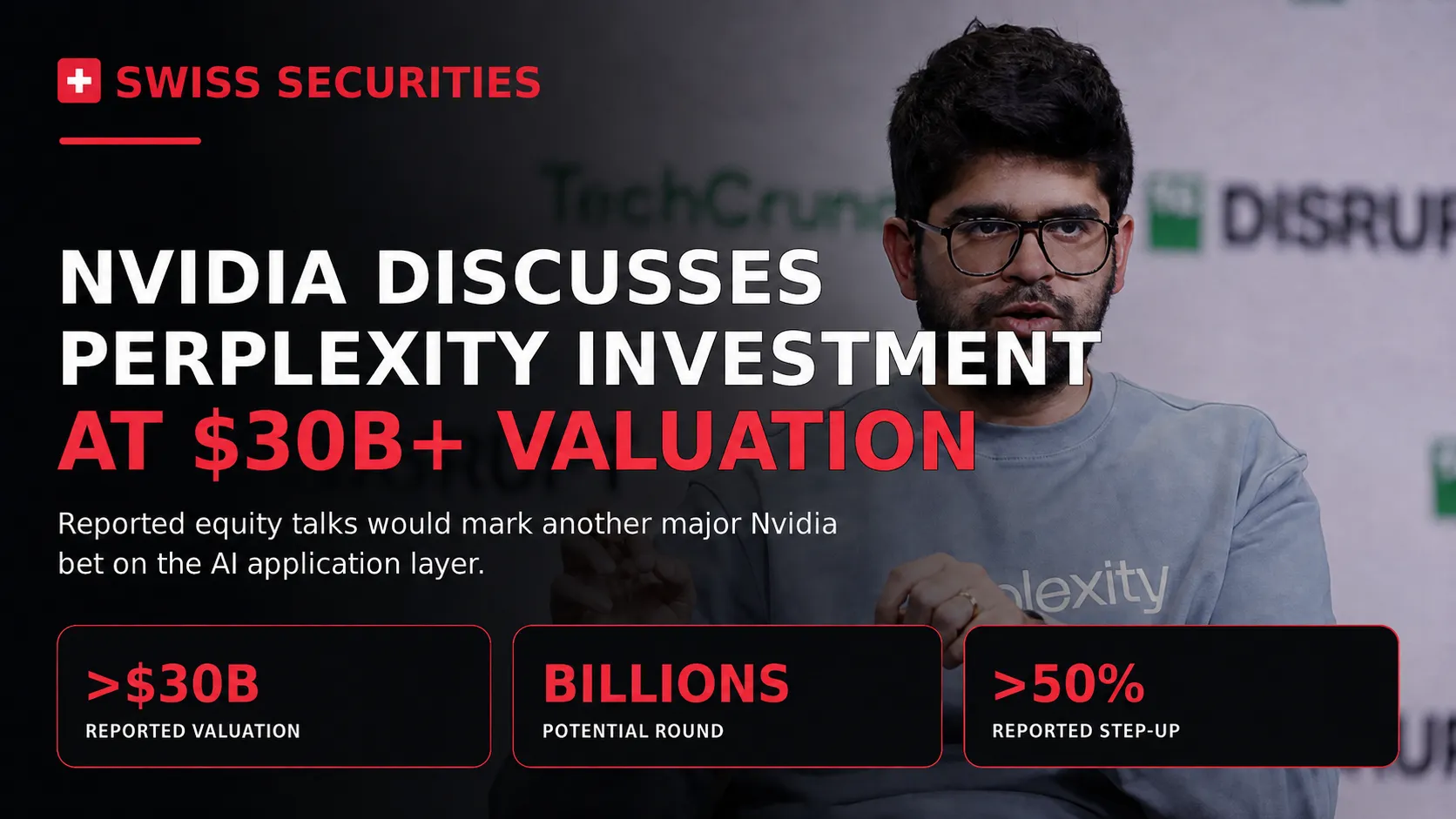
Table of Contents
The New Gold Rush in Artificial Intelligence
Money is pouring into AI with tidal-wave force, reshaping how the technology world values companies. At the center is Perplexity, an AI search and agent business reportedly valued above $30 billion — a signal that investors will pay enormous sums for companies positioned directly between advanced AI models and everyday users.
Invest in top private AI companies before IPO, via a Swiss platform:
Swiss Securities | Invest in Pre-IPO AI Companies
Own a piece of OpenAI, Anthropic & the companies changing the world. Swiss-regulated investment platform for qualified investors. Access pre-IPO AI shares through Swiss ISIN certificates.
 SmartProfit Finder AG
This is the modern gold rush. Rather than training the world's biggest model, Perplexity focuses on making AI practical: helping people search, synthesize answers, and complete tasks through software agents. That user-facing position creates loyalty, subscriptions, and expanding revenue streams — turning a smart assistant today into a travel booker, work organizer, or task automator tomorrow.
The jump from a prior valuation of roughly $20 billion signals that investors see faster monetization and greater strategic importance than before. AI has moved from futuristic concept to commercial race, and companies that make complexity feel effortless are being treated as scarce, valuable assets.
Why Nvidia Keeps Showing Up at the Center of the Story
Nvidia is no longer just a chip company — it has become the central power station of the AI economy. Its reported interest in Perplexity fits a clear strategy: back promising AI applications, and those applications consume more computing power, driving more demand for Nvidia hardware. The relationship is self-reinforcing.
By taking minority stakes in user-facing AI leaders, Nvidia strengthens its ecosystem while reducing the risk of being confined to a narrow infrastructure role. It is not merely selling picks and shovels in a digital gold rush — it is helping decide where miners dig. For investors, this adds a crucial dimension: Nvidia's presence signals which AI categories the industry's most powerful infrastructure company believes will matter most.
Perplexity's Business Model Makes AI Easier to Grasp
Perplexity's promise is simple: help users find answers faster, with less friction. Traditional search returns a list of links; Perplexity synthesizes direct responses and increasingly acts on behalf of users through software agents. That shift — from search to execution — moves the platform toward indispensability.
Reported figures suggest annualized revenue climbed from below $250 million to above $750 million, a progression that signals commercial traction, not just curiosity. The model spans consumer search, professional research, productivity software, and enterprise automation, creating multiple monetization paths. When technology feels simple to the user, it often becomes powerful in the market.
The Competitive Battle for Search, Agents, and Attention
Whoever becomes the preferred doorway into digital information could gain extraordinary influence. Perplexity competes against incumbents with vast resources and billions of existing users — yet history shows platform shifts create openings even when giants appear unshakable. Users adopt new experiences that feel dramatically better, and habits can change faster than large competitors can respond.
The real prize is capturing user intent — and with agents, capturing execution too. A trusted AI assistant could influence commerce, advertising, enterprise workflows, and decision-making across the digital economy. The competitive battle will be won not by novelty, but by execution, trust, and durable economics.
What This Means for Investors Watching the AI Revolution
The clearest investment lesson: AI applications with real users and real revenue are becoming central to the next technology cycle. The market's center of gravity is shifting from infrastructure excitement toward monetized workflows — proof that AI can do work, save time, and generate cash.
Nvidia's involvement creates a compelling feedback loop: better applications fuel more compute demand, stronger compute supply enables better applications, and the entire ecosystem expands together. For public equity investors, rapid AI application scaling could sustain demand for accelerated computing, cloud services, and enterprise software well beyond current expectations.
In the end, the story is simple. AI is moving from spectacle to utility, and money is following. That is where disruption turns into value.