
OpenAI’s 2027 IPO Path Comes Into Focus
4 min read
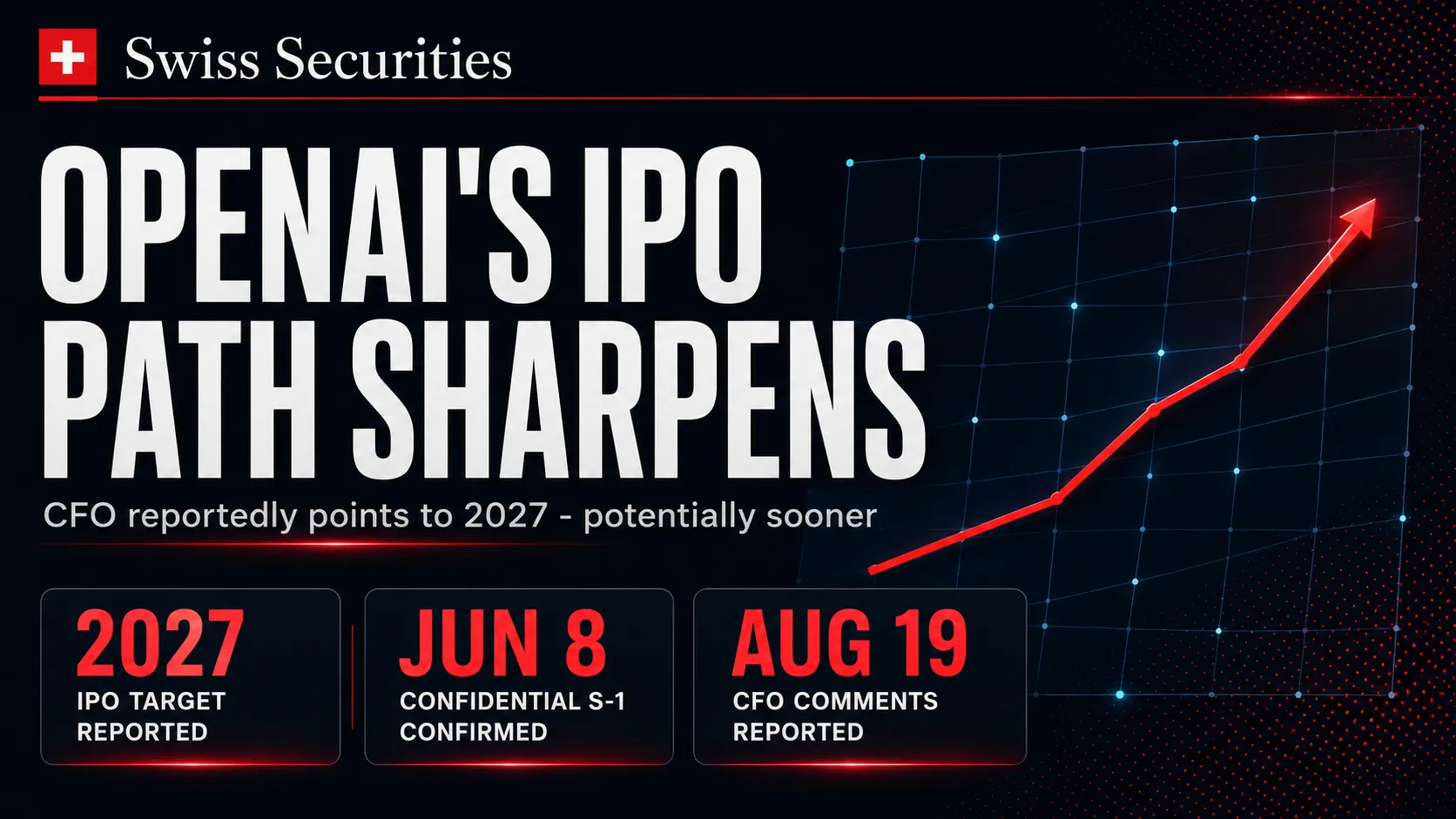
Table of Contents
A Confidential Filing Turns a Rumor Into a Real Road
OpenAI has confirmed it confidentially submitted a draft S-1 registration statement to the SEC. The door to the stock market is no longer a theory — it is open. A confidential S-1 is one of the clearest signals a private company is seriously preparing for public life. Think of it as stepping backstage before a major performance: costumes on, lights warming, script being rehearsed.
Invest in top private AI companies before IPO, via a Swiss platform:
Swiss Securities | Invest in Pre-IPO AI Companies
Own a piece of OpenAI, Anthropic & the companies changing the world. Swiss-regulated investment platform for qualified investors. Access pre-IPO AI shares through Swiss ISIN certificates.
 SmartProfit Finder AG
OpenAI has not declared a listing date, stock exchange, ticker symbol, or share price. The company has created the option to go public without promising a specific day. That distinction matters. The confidential route lets management refine disclosures and strengthen financial presentation before everything becomes visible — delaying the most intense phase of scrutiny until the company is more ready.
Why does this matter beyond Wall Street? Because OpenAI sits near the center of one of the most important technology waves in years. Generative AI is reshaping business strategy, labor productivity, cloud infrastructure, and national competition for technical leadership. A confirmed filing transforms the conversation from abstract possibility into visible preparation — and visible preparation has consequences for investors, employees, competitors, customers, and regulators alike.
The 2027 Target: A Timeline With Excitement, But Not a Promise
OpenAI reportedly expects to go public in 2027, with the possibility of moving earlier if business momentum strengthens. That signal reportedly came from CFO Sarah Friar during an internal all-hands meeting. It is a powerful clue — not yet a formal commitment.
Timing can shape everything. Investor appetite, technology sentiment, interest rates, and competitive dynamics all shift. A weak market can force even a strong business to wait; a powerful growth surge can pull timing forward. The possibility of an earlier debut is just as intriguing as the 2027 target itself — suggesting management sees momentum as a real variable.
A reported timeline changes behavior even before a prospectus becomes public. Venture backers imagine valuation scenarios. Public-market funds build internal frameworks. Rival companies consider accelerating their own plans. The market begins rehearsing a future event long before the opening bell rings. The significance of 2027 is not certainty — it is clarity. Enough clarity to focus attention and turn excitement into models.
Why OpenAI Needs So Much Capital: The Expensive Engine Behind the Magic
AI can feel weightless to the user, but behind every prompt sits an industrial machine of staggering scale. Training and serving frontier models requires giant data centers, advanced chips, power, cooling, and elite engineering talent. The magic is digital. The cost is physical.
Every user interaction carries a cost. When usage explodes, revenue grows quickly — but so does the infrastructure bill. This creates a core tension in AI economics: popularity is good, but popularity burns fuel. Smarter models require training on vast data using specialized chips, and then immense computing resources to deliver every answer at scale.
Public capital could fund the next wave of buildout — data centers, chip purchases, global expansion — while giving the company a flexible currency in tradable shares for compensation and strategic deals. But fuel comes with conditions. Public shareholders ask whether costs can fall relative to revenue over time, whether enterprise customers stick around, and whether management can balance growth with efficiency. The future arrives wrapped in invoices. Whoever masters that engine may shape the next era of technology.
From Private Freedom to Public Scrutiny: The Governance Test
Going public is never just about raising money. OpenAI's structure — combining nonprofit control, public-benefit ambitions, and commercial objectives — is unusual, and public markets do not rely on trust alone. They ask how decisions are made, whose interests come first, and how accountability works when trade-offs become difficult.
If commercial success and public-benefit commitments pull in different directions, who decides? On what principles? Public investors would want visibility into revenue composition, cost structure, customer concentration, and governance mechanics. Ambiguity can be expensive. In a listed company, governance can feel abstract until money is on the line — then it becomes intensely practical.
The discipline of quarterly reporting also changes internal behavior. Research breakthroughs do not arrive on schedule. Safety investments may reduce near-term margins. Infrastructure spending may depress cash flow before revenue catches up. Public investors can support these things if the strategy is disciplined and the governance is sound — but belief must be earned through disclosure and consistency. Private companies can write their story behind closed doors; public companies must write it in front of an audience, under pressure, and in detail.
The Wider AI Race: Why One Listing Could Reset the Entire Market
A potential OpenAI listing is not just a company event — it is a market event. One major listing can create a benchmark, shaping expectations, pricing, strategy, and ambition across the entire sector. Anthropic is also widely expected to pursue a listing, creating a fascinating dynamic: whichever business reaches public markets first could establish the first widely observed valuation framework for frontier AI.
A successful listing could reopen a major liquidity channel for private investors and lift sentiment around other growth companies waiting on the sidelines. It would add real public numbers to conversations currently dominated by rough analogies and excitement — forcing stronger discipline across the sector. Investors may start demanding clearer proof of revenue durability, pricing power, and cost control.
Enterprise customers, watching closely, gain confidence in vendors with capital access and governance maturity. Talent pipelines strengthen when equity becomes more tangible. And ultimately, one breakthrough listing could separate impressive technology from durable business models — rewarding the strongest operators and exposing weaker narratives.
The path is no longer imaginary. The date is not final, the costs are massive, the scrutiny will be fierce, and the market impact could be historic. This is what a real technology turning point looks like.