
Starcloud’s $250M Raise Fuels Orbital AI Data Center Ambitions
3 min read
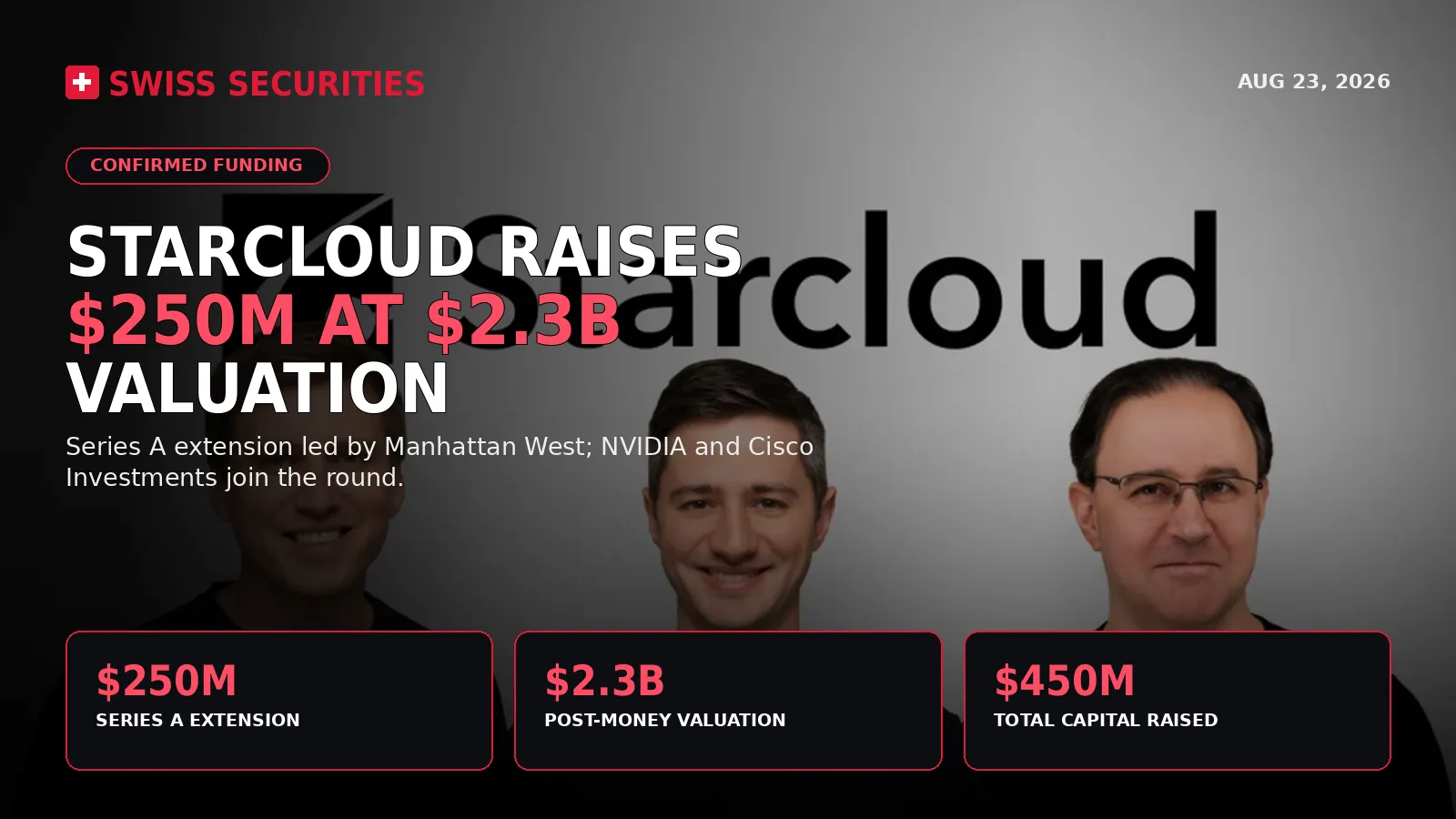
Table of Contents
Orbital AI Compute: Where Science Fiction Meets Business Reality
Starcloud is pursuing a radical vision: placing AI computing power in orbit rather than inside traditional Earth-bound data centers. As artificial intelligence demands ever-increasing compute capacity, conventional infrastructure struggles to keep pace. Starcloud's answer is bold—move some of that workload into space, where satellites offer constant solar energy, unique thermal conditions, and an entirely new frontier for digital infrastructure.
Invest in top private AI companies before IPO, via a Swiss platform:
Swiss Securities | Invest in Pre-IPO AI Companies
Own a piece of OpenAI, Anthropic & the companies changing the world. Swiss-regulated investment platform for qualified investors. Access pre-IPO AI shares through Swiss ISIN certificates.
 SmartProfit Finder AG
This isn't just another startup with a futuristic pitch. It sits at the intersection of space engineering, semiconductor partnerships, and hyperscale infrastructure thinking—precisely where disruptive technologies tend to emerge. If orbital compute works at scale, it could reshape where computing capacity is built, who controls it, and how quickly it grows.
$250 Million at a $2.3 Billion Valuation Signals Serious Conviction
Starcloud's latest financing round speaks volumes. A $250 million Series A extension, valuing the company at $2.3 billion, follows a previous raise at just $1.1 billion—a more than doubling in months. Total capital raised since the company's 2024 founding now stands at $450 million, led by Manhattan West alongside returning and new strategic investors.
In frontier technologies like space infrastructure and AI hardware, experienced investors don't commit meaningful capital casually. Their involvement signals confidence in the technology, management, and market opportunity. More practically, this capital buys time, talent, and momentum—essential assets for a business building an entirely new industrial stack before scale economics appear.
Early Technical Milestones Turn Imagination Into Evidence
Bold ideas become investable when they start working. In late 2025, Starcloud launched Starcloud-1 carrying an NVIDIA H100 GPU. The system reportedly trained an AI model in orbit, ran a version of Google Gemini, and demonstrated both inference and fine-tuning on flight hardware—core functions of modern AI infrastructure, executed in one of the harshest environments imaginable.
This shifts the conversation from "could it work?" to "how far can it scale?" Demonstrating functional orbital AI hardware builds technical credibility, attracts talent and partnerships, and establishes early-mover positioning in a market where timing matters enormously. The gap between demonstration and profitable deployment remains significant, but crossing this threshold is something most deep-tech startups never achieve.
NVIDIA Partnership and Manufacturing Expansion Point Toward Scale
Vision gets attention; production determines who lasts. Starcloud's collaboration with NVIDIA on the Space-1 Vera Rubin Module—hardware adapted specifically for radiation and thermal conditions in orbit—represents a critical bridge from concept to scalable product. Co-developed, orbit-ready silicon is far harder to replicate than a marketing slogan, forming genuine barriers to competition.
New capital is funding a 100,000-square-foot manufacturing facility in Woodinville, Washington, supporting development of the Starcloud-3 spacecraft. This signals a shift from isolated experimentation toward repeatable production. Combined with future launch capacity planning, the company appears to be assembling an integrated operating model—purpose-built hardware, scalable manufacturing, and reliable deployment—the real machinery of long-term value creation.
Enormous Prize, Real Risks: The Tension at the Core
Starcloud's long-term target—an 88,000-satellite constellation delivering 20 gigawatts of orbital compute—is breathtaking in scale. If realized, it would represent an entirely new layer of global digital infrastructure, potentially capturing a significant share of the world's surging AI compute demand.
But execution risk is equally significant. Orbital hardware must withstand radiation, extreme thermal conditions, and limited maintenance access. Launch availability must be reliable and affordable. Most critically, orbital compute must compete economically against Earth-based data centers that are themselves expanding rapidly. A technology can be brilliant and still fail commercially without a compelling cost advantage.
The next few years will determine whether orbital AI compute becomes a genuine infrastructure category or an ambitious experiment. Either outcome carries lessons. If Starcloud succeeds, it may redraw the map of computing itself. The sky is no longer the limit—it's the battleground.