

Stripe Eyes $10 Billion OpenRouter AI Deal
4 min read
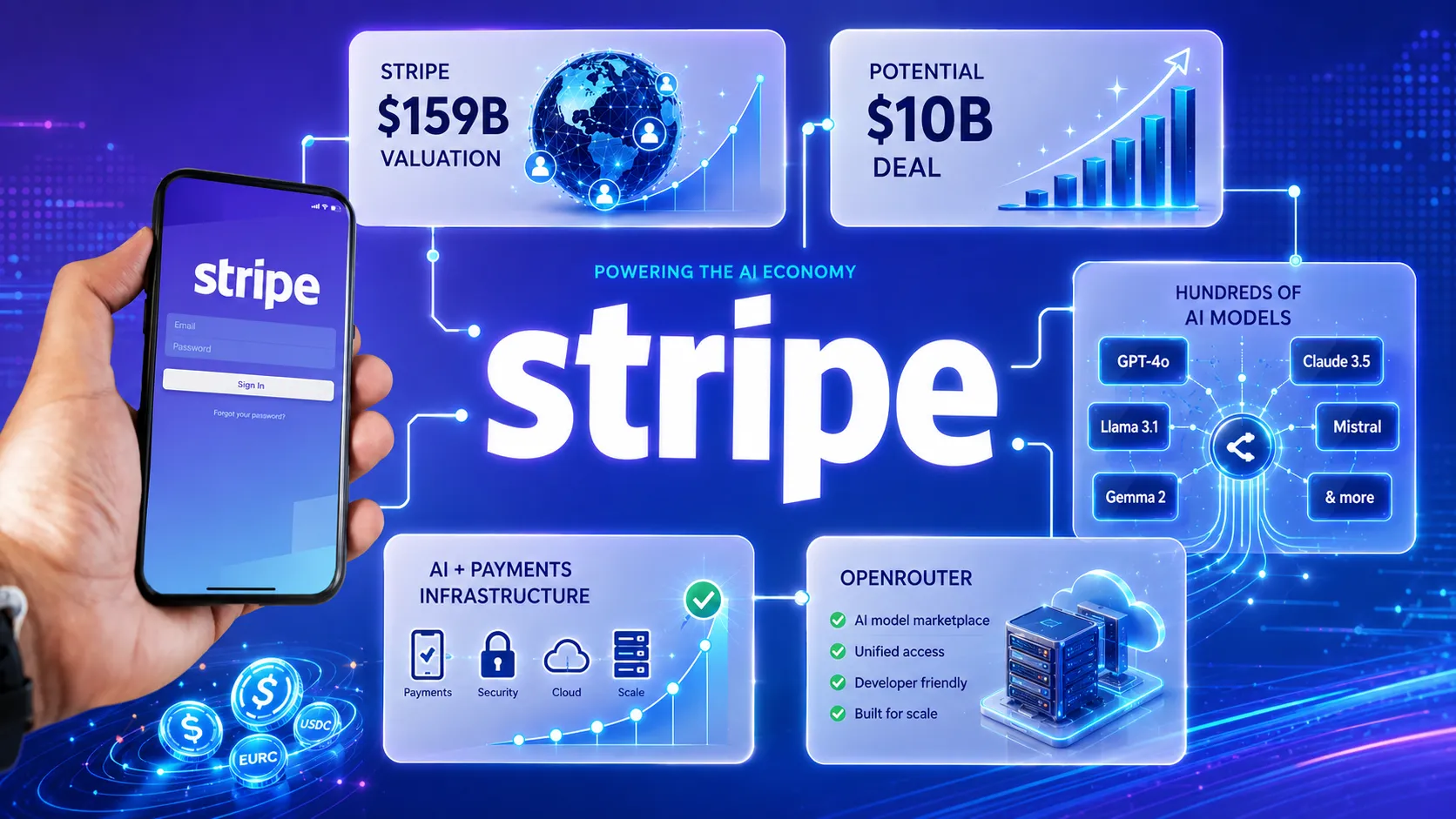
Table of Contents
The New Tollbooth on the AI Highway
Every major technology cycle creates obvious winners, but some of the most durable businesses emerge one layer below the headline products. In AI, attention initially centered on companies building large models capable of writing, coding, reasoning, and generating images. A different opportunity is now emerging around services that help developers compare, connect, and switch between those models efficiently.
Invest in top private AI companies before IPO, via a Swiss platform:
Swiss Securities | Invest in Pre-IPO AI Companies
Own a piece of OpenAI, Anthropic & the companies changing the world. Swiss-regulated investment platform for qualified investors. Access pre-IPO AI shares through Swiss ISIN certificates.
 SmartProfit Finder AG
An AI routing service simplifies a fragmented market. Developers do not want to manually evaluate which model is fastest, most accurate, or most cost-effective for every workload. One model may perform better in customer support, another in software development, and another in document analysis. A common access layer can reduce that complexity by giving businesses a consistent way to use multiple providers.
The economic logic is attractive because companies controlling access can participate in activity across the broader ecosystem without developing every underlying model themselves. Similar to payment networks that earn revenue from transactions rather than manufacturing the products being sold, an AI intermediary can generate recurring income from usage while also providing billing, analytics, optimization, and security services.
As more developers use the service, more model providers have an incentive to participate, increasing the usefulness of the network. Over time, a simple routing product can expand into a broader operating layer for enterprise AI consumption, particularly as organizations adopt multiple models instead of relying on a single provider.
Why Flexibility Is Becoming the Most Valuable Feature in AI
The first phase of AI adoption was driven largely by model capability. The next phase is increasingly focused on how businesses deploy those models efficiently without becoming overly dependent on one supplier. No single system is likely to remain the best choice for every workload, particularly as performance, cost, and availability change rapidly.
A routing service reduces vendor lock-in by allowing organizations to switch models without rebuilding applications from scratch. If one provider experiences an outage, workloads can move elsewhere. If another model delivers better performance or lower costs, businesses can adjust quickly. This flexibility also supports financial discipline by matching premium models with high-value tasks while directing routine workloads toward more economical alternatives.
Open-weight models add another layer of competition. A service that supports both proprietary and open alternatives gives customers broader choice while encouraging providers to compete on price, performance, and reliability. As the AI market matures, this optionality may become increasingly important to enterprises seeking control over both technology and cost.
Why a Payments Giant Would Want a Piece of AI Infrastructure
A payments company and an AI routing business share several underlying characteristics: both depend on transaction volume, trust, reliability, and deep integration into customer workflows. Once developers rely on a service for model access, billing, and operational management, it becomes difficult to replace without creating disruption elsewhere in the product stack.
The overlap is particularly clear in usage-based billing. AI consumption is measured continuously through requests, tokens, and processing volume, creating complex pricing relationships between providers and customers. A company experienced in digital payments already understands metered billing, fraud prevention, international transactions, and high-volume financial infrastructure, making those capabilities highly relevant to AI services.
An acquisition would also give a payments company exposure to AI without requiring it to predict which individual model ultimately dominates. It could instead participate through the infrastructure developers use regardless of the underlying provider. The strategic value extends further through cross-selling, billing integration, and visibility into how businesses consume AI across different workloads.
From Billion-Dollar Startup to Strategic Prize
When an emerging infrastructure company attracts acquisition interest at a valuation well above its recent funding round, investors are often pricing strategic fit rather than current revenue alone. A business with strong developer adoption, broad model coverage, and a reputation for neutrality can become difficult to replicate once it reaches sufficient scale.
Neutrality is particularly important. Developers are more likely to trust a routing layer that does not force them toward one preferred model provider. That independence can strengthen adoption while increasing the value of the service to both customers and model companies. Reproducing that position would require not only technology, but also integrations, developer relationships, billing systems, historical usage data, and established trust.
This helps explain why a strategic buyer may prefer acquisition over internal development. Building the underlying technology may be possible, but recreating an existing network of users, integrations, and provider relationships can take much longer. Competitive interest can also increase a target's value because buyers may view ownership as both an offensive opportunity and a way to prevent rivals from gaining control over an important access point.
The Bigger Investment Lesson Hidden Inside the Deal Talk
Disruptive technology creates value not only for companies building the most advanced products, but also for businesses that make those products easier to deploy, manage, and scale. For enterprises, the practical AI questions increasingly concern model selection, billing, reliability, governance, and cost optimization rather than model capability alone.
Companies operating in this layer can benefit from several market outcomes at once. Wider AI adoption increases usage. Greater model competition increases the need for routing and comparison. Enterprise demand for flexibility strengthens the value of independent access layers. Over time, services that begin with connectivity can expand into billing, optimization, governance, security, and enterprise tooling, increasing both revenue opportunities and customer switching costs.
The broader investment lesson is that AI is becoming less like a single product category and more like an operating layer across business. Companies that make model access flexible, manageable, and economically efficient may become increasingly important as adoption expands. The long-term value may therefore accrue not only to the companies building intelligence, but also to those organizing how businesses access and use it.
https://www.wsj.com/tech/ai/stripe-in-talks-to-buy-buzzy-ai-model-marketplace-openrouter-decc6a74